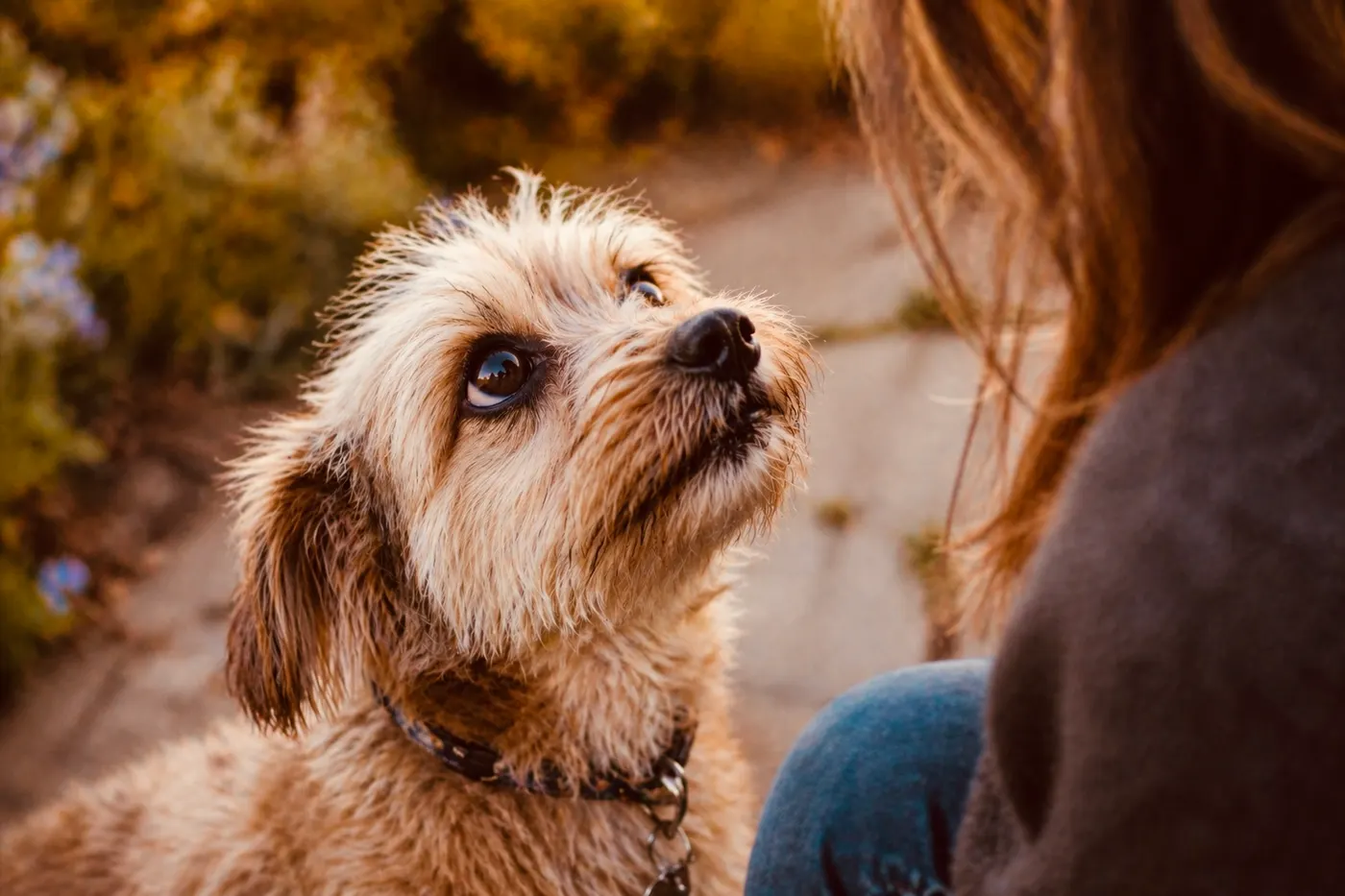
- When you and your dog gaze at each other, both of your brains release oxytocin — the bonding hormone. This is the same mechanism that bonds parent to child.
- Wolves raised by humans don’t do this. It evolved specifically in dogs during domestication.
- Saying “I love you” in a warm tone activates your dog’s brain reward centre as powerfully as food — and some dogs prefer praise to treats
- Most dogs don’t naturally enjoy hugs. 81% show stress signals when hugged. They tolerate it because they love you.
- Dogs lick you for affection. You kiss them for yours. Neither species fully understands the other’s gesture — but both learn.
- A dog’s “smile” can mean happiness, appeasement, or stress. Context and body language tell you which.
The Gaze: Where It All Starts
In 2015, a team at Azabu University in Japan published a study that reframed everything we thought we knew about the human-dog bond. They measured oxytocin levels in dogs and their owners before and after a period of interaction, and found something extraordinary: mutual gazing — simply looking into each other’s eyes — triggered an oxytocin feedback loop in both species. The longer the gaze, the higher the oxytocin. The higher the oxytocin, the more gazing. A self-reinforcing cycle of bonding.
This is the same mechanism that bonds a human mother to her infant. It’s the neurochemical foundation of attachment. And it exists between you and your dog.
The researchers tried the same experiment with wolves raised by humans. Nothing happened. No oxytocin loop. No bonding response to eye contact. Wolves don’t gaze at humans the way dogs do — in fact, in wolf communication, sustained eye contact is a threat. Dogs evolved past that. Somewhere during the 15,000 years of domestication, dogs developed the ability to look at us in a way that hijacks our parental bonding system. They didn’t just learn to live with us. They learned to love us in a way our brains could feel.
When your dog looks at you with those soft eyes — really looks, not staring for food or waiting for a command, but that quiet, relaxed gaze — they are doing something no other animal on earth does. And your brain is responding exactly as if your child were looking at you.
“I Love You”: What Your Dog Actually Hears
You can’t explain love to a dog. But you can express it in a way their brain registers as reward.
A landmark fMRI study at Eötvös Loránd University in Budapest scanned dogs’ brains while they listened to praise words spoken in different tones. The dogs’ brains processed what was said (left hemisphere) and how it was said (right hemisphere) separately — then combined both in their reward centre. Praising words in a praising tone — “good dog,” “I love you,” “clever girl” — activated reward circuits equivalent to receiving food.
But here’s the key: it had to be both. Praise words in a flat tone didn’t work. An enthusiastic tone with meaningless words didn’t work either. Your dog isn’t just responding to your energy. They’re processing the words AND the feeling behind them. Tone matters more than most owners realise — the same acoustic sensitivity that lets dogs distinguish reggae from heavy metal is what lets them read warmth in your voice. When you tell your dog you love them and you mean it — warm voice, soft eyes, genuine feeling — their brain lights up.
An Emory University study went further. When given the choice between praise from their owner and food, some dogs consistently chose praise. Brain scans predicted which dogs would make that choice — the ones with stronger reward activation for their owner’s voice over food would later walk past a bowl of treats to reach their person.
Your words matter. Your tone matters. Your sincerity matters. Your dog can tell the difference.
Kissing, Licking, and the Language Gap
Here’s where love gets complicated — and where paying attention to your dog matters most.
You kiss them. They don’t understand it — at first. Kissing is a purely human behaviour. Dogs don’t kiss each other. When a human face comes straight at a dog’s face, the dog’s instinct may be confusion, anxiety, or even a perception of threat. Dogs approach each other in curves, not head-on. A face moving directly toward theirs violates their natural social grammar.
But dogs are extraordinary learners. Over time, most dogs associate your kisses with the warmth, the tone of voice, the gentle touch that accompanies them. They learn that this strange human behaviour means affection. Some dogs come to genuinely enjoy it — they lean in, close their eyes, relax. Others tolerate it because they love you, even though it’s not their preferred language.
They lick you. You might not understand it — at first. When your dog licks your face, they’re doing their version of affection. Licking releases endorphins in dogs. It’s a behaviour rooted in puppyhood — puppies lick their mother’s mouth to stimulate feeding, and it carries into adulthood as a signal of trust, submission, and connection. Your dog licking your face is one of the most sincere compliments they can pay you. Whether you enjoy receiving it is another matter entirely.
The takeaway: you and your dog are speaking different affection languages. Neither of you fully understands the other’s gestures instinctively. But both of you learn. That mutual effort — the willingness to meet each other halfway in a language neither species was born speaking — might be the most beautiful thing about the relationship.
Why Most Dogs Don’t Love Hugs
This one hurts to hear, but it’s important.
Dr. Stanley Coren studied hundreds of photographs of humans hugging dogs and found that 81% of dogs showed at least one sign of stress — lip licking, tense muscles, whale eye (showing the whites of their eyes), ears back, turning away. Only about 8% appeared genuinely comfortable.
The reason is physical: a hug restrains movement. For a dog, being held in place — unable to move away — triggers the same anxiety as being trapped. Dogs don’t hug each other. When one dog pins another, it’s either play-fighting or real fighting. The sensation of being wrapped and held doesn’t have a positive reference point in their behavioural repertoire.
This doesn’t mean your dog hates you for hugging them. Many dogs tolerate hugs from their person because the relationship is strong enough to override the discomfort. Some dogs — particularly those raised with a lot of physical handling from puppyhood — genuinely seem to enjoy it. But if your dog goes still when you hug them, turns their head away, or yawns, they’re telling you something. They’re not rejecting your love. They’re asking for it in a different form.
What most dogs prefer: leaning against you (on their terms), lying beside you with body contact, a slow scratch behind the ears, a chest rub, or simply being in the same room. Closeness without restraint. Presence without pressure.
The Smile Question
Your dog smiles at you. But what does it mean?
The relaxed open mouth — soft eyes, loose body, tongue possibly out — is the closest thing to a genuine happy expression. This is the face of a contented dog. It’s not technically a smile in the human sense, but it’s a reliable indicator of positive emotion. Dogs have learned that this expression gets a positive response from humans, which reinforces it. Over time, some dogs develop a “greeting smile” that’s genuinely joyful.
The submissive grin looks similar but means something different. Teeth visible, head lowered, eyes squinting, body tense or low. This is appeasement — “I’m not a threat, please don’t be upset with me.” It’s often mistaken for guilt (the “guilty dog” videos online are almost always submissive grins, not guilt). The dog isn’t happy. They’re trying to defuse tension they’ve sensed in you.
The key is context and body language. A relaxed body + open mouth = contentment. A tense body + visible teeth + lowered head = appeasement or stress. A stiff body + vertical lip lift + hard eyes = warning. Read the whole dog, not just the face.
Puppies and smiling is worth noting: a young puppy showing teeth may be experimenting with social signals. They haven’t yet learned the full repertoire. What looks like a smile in a puppy might be uncertainty, playfulness, or an attempt to mimic what gets a positive response from their human. Over time, dogs learn which facial expressions produce warmth and treats and attention — and they lean into those expressions. In that sense, your dog’s smile is partly learned. They smile because you smile back. That’s not fake. That’s relationship.
Building a Cuddly Dog: What Happens in the First Weeks
If you want an adult dog who melts into your lap, leans against your legs, and seeks closeness — a lot of that is built in puppyhood. Not all of it. Breed temperament and individual personality matter. But the research on early handling is striking.
The socialisation window (3–16 weeks) is when a puppy’s brain is wiring its relationship with touch, closeness, and human contact. Puppies handled gently every day during the first weeks of life were measurably calmer at 8 weeks than puppies who weren’t handled. The key word is gently — picking them up, cradling them, touching their paws, ears, belly, mouth. Not overwhelming them. Not forcing cuddles on a puppy who’s pulling away. Positive, calm, brief handling that builds a lifelong association: human touch = safe.
What to do with a new puppy:
- Handle them every day — paws, ears, belly, tail, mouth. Pair it with treats and a calm voice so they associate being touched with good things.
- Hold them on your lap. Let them fall asleep on you. The warmth and heartbeat create the same kind of bonding that the oxytocin gaze does — physical closeness building trust.
- Let them approach you for cuddles rather than always picking them up. A puppy who chooses closeness learns that closeness is rewarding, not imposed.
- Introduce gentle handling by multiple people — not just you. Puppies socialised with a variety of humans are more comfortable being affectionate with people generally, not just one person.
- Watch for stress signals even in young puppies. Squirming, lip licking, yawning, trying to escape — these mean “too much, too soon.” Back off, try again later, keep it positive.
The mistake people make is assuming an adult dog who’s not cuddly was “just born that way.” Sometimes that’s true — some breeds and individuals are naturally more independent. But often, a dog who stiffens at hugs, avoids lap time, or flinches at handling simply missed out on positive touch experiences during the critical window. It’s not too late to build trust through slow, gentle, rewarding physical contact — but it’s much easier if you start in the first weeks.
A dog who loves being close to you didn’t just luck into it. Someone — a breeder, a foster carer, you — taught them that human warmth is the safest place in the world.
The Language You Share
You and your dog don’t speak the same language. You never will. But you’ve built something more remarkable than shared words: a mutual emotional vocabulary that took 15,000 years of coevolution to develop.
Your dog reads your face, your posture, your tone, your breathing, your mood. You read their tail, their ears, their eyes, their body. Neither of you is perfectly fluent. Both of you are trying. The oxytocin loop that fires when you look at each other is the neurochemical proof that the trying works — and the bond itself is measurably protective: the Dog Aging Project found social companionship had a stronger effect on canine health than financial factors.
So tell your dog you love them. Mean it when you say it. And make eye contact — soft, relaxed, not staring — because that simple act of looking at each other is the most powerful bonding tool you have. It’s not a training technique. It’s the 15,000-year-old connection between your species firing in real time. Five seconds of quiet mutual gaze releases more oxytocin than a treat ever will.
Let them lean against you. Let them lick your hand if that’s their thing. Learn what they like and what they tolerate. The difference matters — and recognising it is part of what makes dogs genuinely happy.
The love between you and your dog isn’t the same as human love. It might be simpler. It might, in some ways, be purer. It is certainly, measurably, biochemically real.