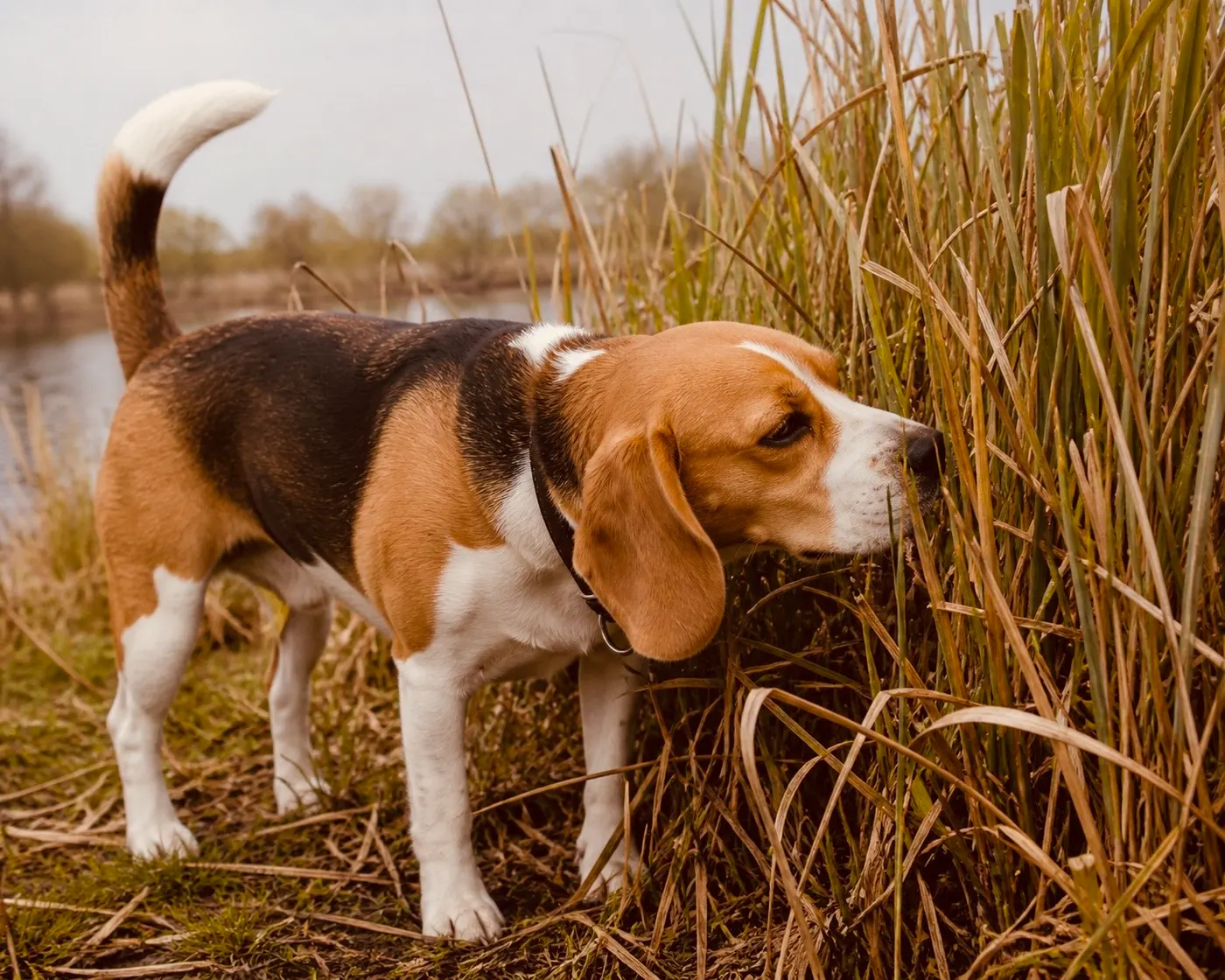
- Sniffing is often the most important part of the walk. For dogs, it’s not a sidebar — it is frequently the walk’s entire purpose.
- Dogs experience the world through scent. Up to 300 million olfactory receptors, a smell-processing brain area 30 times larger than ours, and a recently discovered neural link between smell and sight found in no other species.
- Sniffing supports calmer, more settled behaviour. Research links regular scent engagement to more optimistic emotional states and reduced stress markers.
- A shorter sniff-focused walk can be more satisfying than a longer fast one — especially for anxious, reactive, senior, or recovering dogs.
- The best sign it worked: your dog comes home and settles. Calmly. Deeply.
How Dogs Actually Experience the World
Dogs have up to 300 million olfactory receptors — compared to our roughly six million. The part of their brain dedicated to processing smell is proportionally about 30 times larger. And a brain imaging study discovered a direct neural connection between the canine olfactory bulb and the occipital lobe — the vision centre. This has never been documented in any other species.
When your dog stops to investigate a lamp post, they are reading. A scent mark contains layered information: who was here, when, what sex, whether the animal was stressed or relaxed, and even the direction they were travelling. Imagine being able to read a continuously updating notice board at every corner of your neighbourhood. That’s closer to what your dog processes every time you let them pause.
Sniffing is information gathering, social communication, environmental mapping, mental enrichment, and emotional regulation — simultaneously. When we pull our dogs away from it, we interrupt all of those at once.
What the Science Is Starting to Show
Research is catching up to what many professionals have long observed.
The strongest single study comes from Duranton and Horowitz (2019), who tested whether nosework could affect a dog’s emotional state. Twenty dogs were split into two groups — half did nosework for two weeks, half did heelwork. Both received the same exercise and treats. The nosework dogs showed a significant increase in optimistic responses on a cognitive bias test. The heelwork dogs showed no change.
The difference wasn’t exercise or rewards. It was that the nosework dogs could use their noses freely, move independently, and make their own choices. They had olfactory engagement plus agency.
An honest caveat: nosework specifically trains dogs to approach containers independently, which is also what the cognitive bias test measures. The finding is compelling and directional rather than conclusive proof. But it aligns with a growing body of evidence. A 2018 study on shelter dogs found olfactory enrichment reduced vocalisation and increased sleeping — both markers of reduced stress. A 2024 study found scent work improved inhibitory control. And a comprehensive 2024 review described sniffing as “a natural, species-typical behavior and essential for the dog’s welfare.”
In welfare science terms, denying a dog regular olfactory engagement isn’t just missing an enrichment opportunity. It is a form of behavioural deprivation.
Behaviourists widely report that sniffing appears to shift dogs from an alert, scanning state into a more settled one — though the specific physiological pathway hasn’t yet been confirmed in controlled companion-dog studies. What is consistently observed is the outcome: dogs who get meaningful sniffing time tend to be calmer and more easily able to rest afterward.
What Owners Most Often Get Wrong
None of this is about blame. Most owners have never been told that sniffing matters this much.
“My dog is just being stubborn.” They’re not defying you. They’re engaged in their primary mode of cognition. Pulling them away from a scent is, from their perspective, something like having a book snatched from your hands mid-sentence.
“A good walk is a long walk.” A growing number of professionals now distinguish between exercise walks and enrichment walks. For many dogs — especially anxious, reactive, senior, or recovering ones — a shorter, slower, sniff-focused walk can leave them more settled than a longer, faster one where they barely got to use their nose.
“I need to control the pace.” Not every walk needs to be a structured walk. Designating even one outing a day as “sniff time” — where the dog sets the pace and you follow — can make a meaningful difference.
“Sniffing is just a bit of fun.” It is fun. But welfare science increasingly treats olfactory engagement as a species-typical need, not an optional extra. A dog who never gets to sniff properly is a dog whose most important sensory system is being underused.
Different Dogs, Different Sniffing Styles
All dogs benefit from sniffing, but the way they use it can look completely different. Scent hounds may need significantly more sniffing time — very little ground covered, a lot of nose-in-undergrowth. Terriers show intense, targeted sniffing — locking onto a prey scent, freezing, digging. Retrievers combine scent with a natural instinct to find and fetch — nose-led retrieval games are ideal for them. And companion breeds should not be overlooked — a Cavalier on a snuffle mat is using their olfactory system in exactly the same way.
Two groups where sniffing is especially valuable: senior dogs, for whom it provides mental stimulation when mobility declines, and anxious or reactive dogs, for whom nose-down engagement competes with threat-scanning.
What Makes a Good Sniffing Outing
The richest olfactory landscapes tend to have texture, variety, and enough calm for a dog to process what they’re finding.
Long grass and undergrowth trap and hold scent molecules. Woodland and trails after rain intensify scent through moisture, damp earth, and leaf litter. Beaches at low tide are some of the richest sensory environments a dog can encounter — exposed seaweed, tidal pools, wet sand carrying novel, concentrated scents. Hedgerows and field edges function as wildlife scent corridors. Varied terrain — grass to gravel, earth to mulch — creates different scent profiles within a single walk.
Novelty matters. Dogs sniff more intensively in unfamiliar environments. A new park, trail, or beach is not just a change of scenery for the owner — it’s a genuine cognitive challenge for the dog.
What reduces the benefit? Busy, overstimulating environments where a dog has to process too many social signals alongside the scent. A quieter reserve at a less popular time may offer better conditions for the kind of calm, focused sniffing that actually supports wellbeing. (And the same scent-driven instinct explains why they roll in things you wish they wouldn’t — the line between “rich olfactory environment” and “the dead bird in the long grass” is, from your dog’s perspective, very thin.)
How to Build More Sniffing Into Daily Life
Small shifts make a real difference.
Designate one walk as “sniff time.” The dog leads. They choose the pace, the direction, and how long they spend at each smell. A long line in a safe open space gives more freedom without going off-lead.
Stop pulling past every smell. If your dog pauses at a gate or a grass verge, give them ten seconds. It costs almost nothing and adds genuine enrichment.
Scatter feed. Toss kibble into long grass and let the dog use their nose. Five minutes of scatter feeding can settle a dog more effectively than a game of fetch.
Play “find it” indoors. Using treats in scent work — hidden around the house, scattered in long grass, tucked into a snuffle mat — engages the same cognitive systems that make sniff walks valuable. Free, takes five minutes.
Explore new places. A new park, trail, or beach offers a completely fresh scent landscape. Finding new places isn’t just variety for you — it’s a genuine wellbeing intervention for the dog.
The Big Picture
Sniffing is not wasted time. It is one of the most powerful, accessible, and underrated tools any dog owner has for supporting their dog’s happiness.
The right walk is not always the longest or the fastest. It’s the walk where the dog gets to engage with the world through scent. And one of the most reliable signs that an outing worked is the simplest: the dog comes home and settles. Calmly. Deeply. Just a sigh, a stretch, and sleep.
That’s what a good sniff does. It doesn’t just tire a dog out. It satisfies them.
A good walk doesn’t always look impressive. It just has to work for the dog.
Find the Right Place for Your Dog’s Next Sniff
The next time you’re planning a walk, think about it from your dog’s nose. What does the landscape offer them?
Search for parks, reserves, trails, and beaches near you — and find the places that give your dog the space to sniff, explore, and come home properly satisfied.