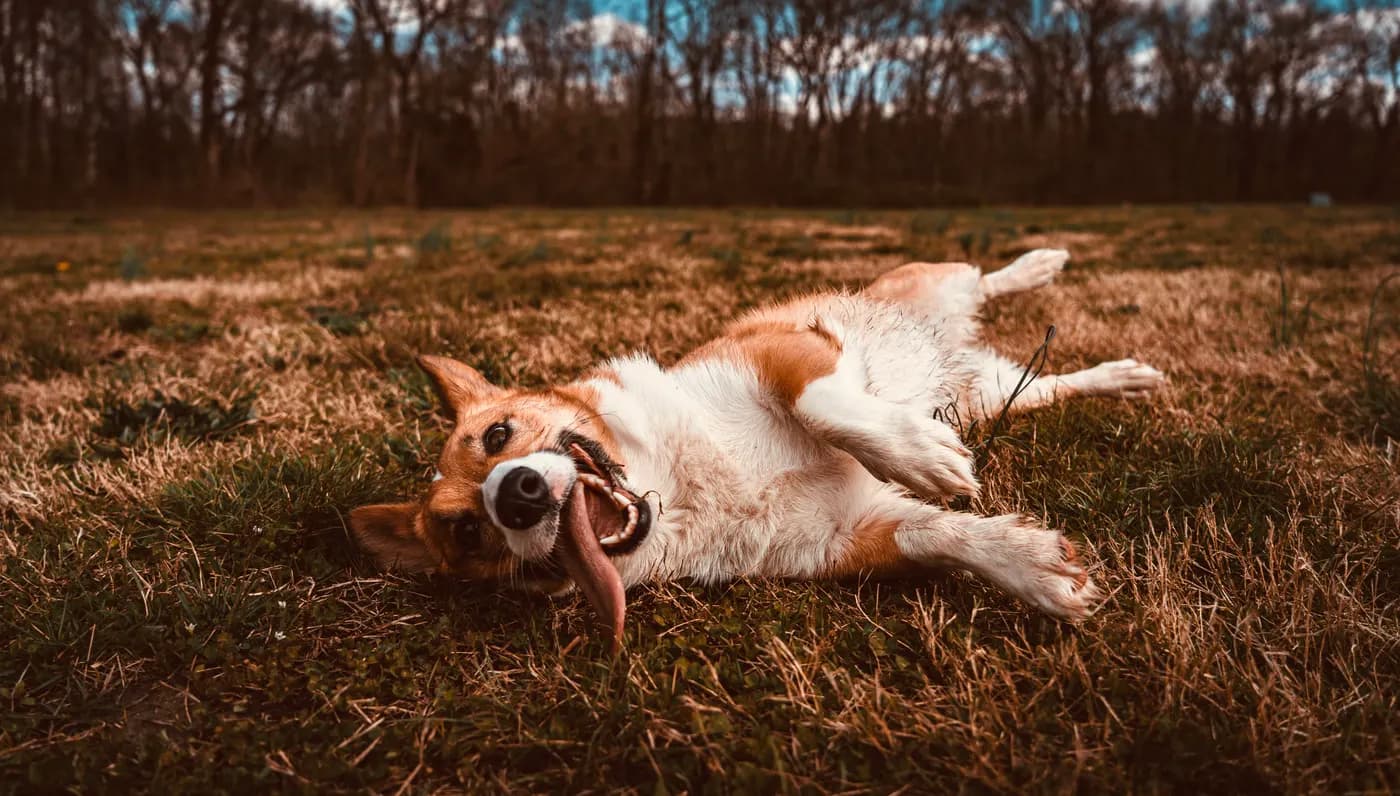
- Rolling in foul-smelling things is called “scent rolling.” It’s instinctive, universal, and nobody knows for sure why dogs do it.
- The leading theories: camouflaging their own scent (wolf ancestry), carrying information back to the pack, or claiming a find as their own
- The simplest explanation may be the truest: it triggers dopamine. It just feels good.
- Your dog’s scent is their identity. A bath erases it. Post-bath zoomies are partly your dog trying to get themselves back.
- Dogs don’t experience “clean” and “dirty” the way you do. They experience “smells like me” and “doesn’t smell like me.”
- Understanding this won’t stop you gagging in the car on the way home. But it might change how you think about the relationship between your dog and their nose.
Why They Do It: Four Theories, No Certainty
Scent rolling is one of those behaviours that every dog owner recognises and no scientist has definitively explained. Wolves do it. Foxes do it. Coyotes do it. Your Labradoodle does it with the same commitment as a wild predator, despite having never hunted anything more dangerous than a squeaky toy.
Theory 1: Scent camouflage. The most popular explanation. Wolves roll in carrion, dung, and other strong-smelling organic material to mask their own scent before a hunt. Prey animals are less suspicious of something that smells like rotting meat than something that smells like wolf. Your dog may be running ancient hunting software — disguising themselves as something dead so they can sneak up on something alive. The fact that they’re sneaking up on nothing doesn’t seem to bother them.
Theory 2: Scent sharing. Pat Goodman, curator of Wolf Park in Indiana, studied this behaviour in wolves and found that wolves who rolled in novel scents returned to the pack and were immediately investigated by other wolves, who sniffed them intensely and then followed the scent trail back to its source. The rolling wolf was essentially carrying a message: “I found something interesting. Follow me.” Your dog rolling in a dead possum and then presenting themselves to you may be the canine equivalent of “You’ll never guess what I found.”
Theory 3: Claiming the find. Some behaviourists suggest scent rolling is a way of marking a resource — wearing the smell says “this is mine” to other dogs. It’s a portable territory marker, a way of broadcasting ownership without having to guard the actual carcass.
Theory 4: It just feels amazing. The least scientific but possibly most accurate theory. Rolling may trigger a rush of dopamine — the neurotransmitter responsible for pleasure and reward. Watch your dog’s face when they roll. The half-closed eyes, the loose body, the full-body wiggle. That’s not a dog performing a survival function. That’s a dog in bliss. Sometimes the simplest explanation is the right one: it feels good, so they do it.
The honest answer is that we don’t know which theory is correct. Probably all of them contribute. What we do know is that scent rolling is deeply instinctive, not learned — puppies do it without being taught, and breeds with no hunting history do it just as enthusiastically as retrievers and hounds.
What They Choose (and What It Tells You)
Dogs aren’t random about what they roll in. The choices are almost always organic — dead animals, animal droppings, rotting food, fish, earthworms after rain. They rarely roll in chemical smells, synthetic materials, or clean surfaces. And they target the neck and shoulders, coating the areas where their own scent glands are most concentrated.
This specificity is what makes the “it just feels good” theory incomplete on its own. If it were purely about pleasure, they’d roll in anything soft. The selectivity — always organic, always pungent, always on the neck — suggests something more deliberate is happening, even if we can’t fully decode it.
Your dog’s nose is processing something in that dead bird that you literally cannot perceive. They have up to 300 million olfactory receptors compared to your 6 million. The part of their brain devoted to analysing smells is proportionally 40 times larger than yours. When they drop onto that carcass, they’re not experiencing “disgusting.” They’re experiencing a dense, complex, fascinating layer of information — and they want to wear it. The way they perceive the world through scent shifts season by season too — what’s on the ground in autumn is a completely different library to what’s there in spring.
Baths, Identity, and the Post-Bath Zoomies
This is where it connects to something bigger than a dead possum.
Your dog’s natural scent is their identity. It’s how other dogs recognise them, how they mark their environment, and how they understand themselves in relation to the world. When you give your dog a bath — especially with scented shampoo — you’re erasing that identity and replacing it with something that smells like lavender and coconut to you, but smells like not them to your dog.
This is why dogs go berserk after a bath. The technical term is FRAPs — Frenetic Random Activity Periods — but everyone calls them zoomies. Your freshly bathed dog tears around the house, rubs against furniture, rolls on the carpet, dives onto their bed, and generally acts like they’ve been possessed. What they’re actually doing is reclaiming their scent. Rubbing against familiar surfaces deposits their natural oils back. Rolling on the carpet picks up the smells of home. The frantic energy is partly stress release (baths are mildly stressful for most dogs) and partly a genuine effort to smell like themselves again.
To you, your dog smells “clean.” To your dog, they smell like a stranger.
Clean vs Dirty: A Human Distinction
Here’s the thing most owners don’t fully absorb: your dog doesn’t experience “clean” and “dirty” the way you do. Those are human categories based on human sensory preferences and human social norms. Your dog experiences “smells like me” and “doesn’t smell like me.” A dog who’s rolled in mud, swum in a creek, and found something questionable under a bush doesn’t feel dirty. They feel like themselves — layered with information about where they’ve been and what they’ve found.
A dog who’s just been bathed with scented shampoo feels stripped. Not clean — stripped. Their identity has been temporarily overwritten. This is why they immediately seek out the nearest patch of grass, dirt, or — if you’re unlucky — the same dead thing they rolled in before the bath.
This doesn’t mean you shouldn’t bathe your dog. Hygiene matters, skin health matters, and nobody wants a dog that smells like decomposition sleeping on their pillow. But understanding the gap between your experience and theirs can change how you approach it.
Practical takeaways:
- Bathe your dog only when they need it — every 4–6 weeks is usually enough unless they’ve found something truly foul. Over-bathing strips natural oils and causes skin irritation.
- Use unscented or mildly scented dog-specific shampoo. What smells “fresh” to you can be overwhelming for a nose that’s 100,000 times more sensitive than yours.
- Let them have the zoomies after a bath. It’s normal, it’s healthy, and it’s their way of coping. Clear the space, let them run, and accept that the carpet will get damp.
- Don’t punish scent rolling. You can interrupt it (a strong recall, a distraction), but punishing a deep instinct doesn’t eliminate it — it just makes your dog anxious about doing something their brain is wired to find rewarding.
The Mud Puddle, the Dead Bird, and the Point
A dog who’s just rolled in something terrible and is trotting back to you with their tail high and their face covered in something unspeakable is not being naughty. They’re being a dog — following an instinct that predates your relationship by tens of thousands of years, processing the world through a sensory system that operates on completely different terms to yours.
You will still need to clean them. You will still gag. The car will still smell for days. But somewhere in the middle of all that, there’s something worth noticing: the sheer, unbothered, full-body happiness of a dog who has just done exactly what their biology told them to do. That’s enrichment you can’t buy at a pet store. That’s a dog being fully, deeply happy.
Even if you wish they’d be happy about something that smells better.