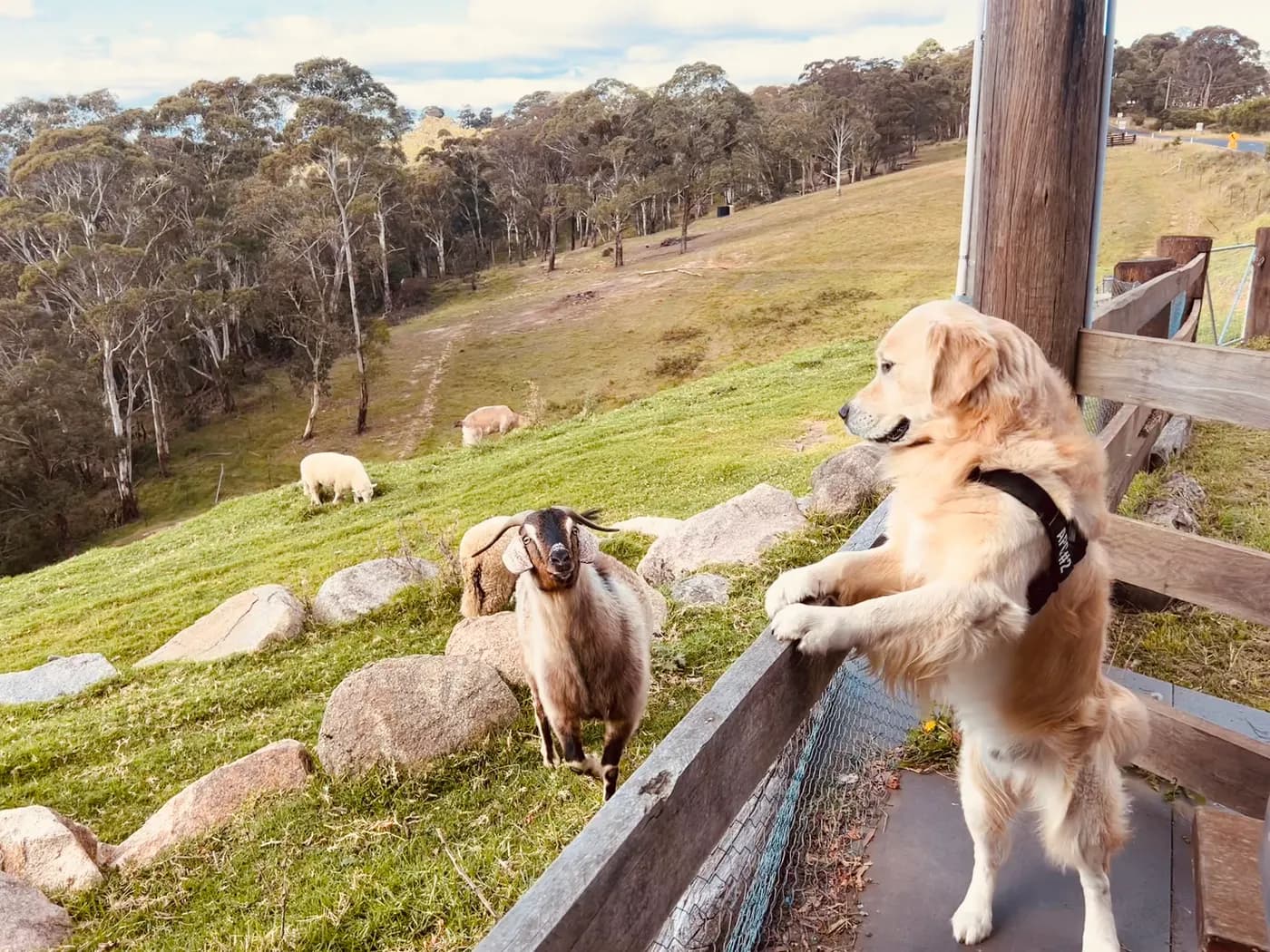
- Farm animal encounters are peak enrichment for most pet dogs — novel sights, sounds, and an olfactory feast
- Most petting zoos and city farms in NSW don’t allow dogs (this surprises people)
- Not every dog is ready — prey drive, herding instinct, and curiosity look very different
- A few specific NSW venues genuinely welcome dogs alongside farm animals
- Always on-lead, always supervised, always reading your dog
Why This Matters for Your Dog’s Happiness
Environmental enrichment research consistently shows that novel experiences reduce stress, increase relaxation, and build resilience. Dogs need variety — not just new parks, but genuinely new categories of stimulation. Farm animals offer something most pet dogs never encounter: a living, moving animal that isn’t a dog, a cat, or a bird in a tree.
And then there’s the smell. A farm environment — hay, manure, wool, grain, different animal scents layered over each other — is an olfactory library. The sensory richness alone makes a farm visit worthwhile. If you’ve read why sniffing matters, you’ll recognise this: a farm is one of the most sensorially complex environments your dog can explore.
The confidence angle matters too. A dog who calmly encounters a goat behind a fence and moves on without stress has built a small piece of resilience. Over time, varied experiences like this produce a dog who’s more adaptable, more settled, and happier.
Not Every Dog Is Ready — and That’s Fine
This is the section that matters most, and it’s worth being honest about.
There’s a real difference between curiosity, herding instinct, and prey drive — and they look very different when your dog sees a chicken for the first time.
Curiosity looks like this: your dog notices the animal, sniffs the air, approaches cautiously, glances back at you. Their body is soft, their ears are relaxed. They’re interested but not locked on. This is the dog who’s ready for a farm visit.
Herding instinct looks different. A Border Collie, Kelpie, or Cattle Dog might drop into a crouch, fix their gaze, and start circling. This isn’t aggression — it’s deeply bred behaviour. But it can seriously stress livestock. Sheep can miscarry from being chased. Even herding behaviour without contact can cause real harm.
Prey drive is something else again. A dog who stiffens, fixates, lunges toward a moving animal, and can’t be redirected is showing predatory behaviour. Terriers, sighthounds, and some northern breeds can have strong prey drive that overrides training, especially around small animals like chickens, ducks, and rabbits.
None of this means your dog can never go near a farm animal. It means you need to know your dog, prepare accordingly, and choose the right setting. A dog with strong prey drive might do fine observing goats from behind a fence but shouldn’t be near free-ranging poultry. A herding breed might need more distance and more practice with calm observation before getting close.
Signs your dog is probably ready: calm on-lead around distractions, reliable recall, curiosity without lunging or fixating, previous experience with novel environments without becoming overwhelmed.
Signs your dog needs more preparation: chases cats, birds, or small animals; fixates intensely on anything that moves; poor recall around distractions.
How to Make It Work
- Start at distance. Don’t walk straight up to a paddock fence. Let your dog take in the new sights, sounds, and smells from ten or fifteen metres away.
- Read your dog. Soft body, loose tail, relaxed sniffing = curiosity. Stiff body, forward lean, fixed stare, raised hackles = arousal that needs managing.
- Keep the lead on. Non-negotiable, even if your dog is normally reliable off-lead. Farm environments are high-stimulus and unpredictable.
- Let the farm animal set the pace. If goats approach the fence, let them. If livestock moves away, don’t follow.
- Reward calm behaviour. Treats and quiet praise for looking at the animal calmly, for checking in with you, for sitting quietly near the fence.
- Keep it short. Ten minutes of calm observation is better than thirty minutes of escalating excitement.
- Don’t force it. If your dog is stressed — lip licking, yawning, whale eye, pulling away — respect that. Not every dog needs to love farm animals.
One thing worth remembering: the farm animals matter too. Dogs can stress livestock even without physical contact. Clean up after your dog — dog faeces can spread disease to grazing animals. Keep a safe distance from large animals like horses and cattle, which can kick. And always respect fences and enclosures.
Where to Actually Go
Here’s the practical challenge. Most petting zoos and city farms in NSW — Calmsley Hill, Taronga’s farmyard, Symbio, Where Pigs Fly Sanctuary — don’t allow dogs. Even some farm stays that look perfect, like Starline Alpacas in the Hunter Valley, have a no-pets policy. Finding places where your dog and farm animals can genuinely coexist takes more research than you’d expect. (For more day-trip dog events beyond farm visits — festivals, regional shows, country pub events — see our full NSW calendar.)
These are the places we’ve found that welcome both.
Day Trips
Bilpin Cider Farm, Bilpin (Blue Mountains)
A 10-acre working cider farm with alpacas, miniature donkeys, goats, sheep, and free-ranging chickens — all named, all accustomed to visitors. Dogs are explicitly welcome on-lead, and there’s plenty of room to explore the grounds while the animals go about their day. Combine farm animal encounters with a cider tasting and a walk through the orchards. About 90 minutes from Sydney.
Megalong Creek Estate, Megalong Valley (Blue Mountains)
A family-run boutique vineyard where alpacas graze right in front of the cellar door, framed by towering sandstone escarpments. Dogs are welcome. You can taste single-vineyard wines and cheese platters while your dog watches the alpacas from a few metres away. Two minutes down the road, Dryridge Estate is another dog-friendly cellar door with resident dogs and spectacular views. Together they make a genuine Blue Mountains day trip — wine, scenery, and farm animals. About two hours from Sydney, 20 minutes from Blackheath.
Hunter Valley Wineries
Several Hunter Valley cellar doors sit on rural properties where dogs encounter winery dogs, open paddocks, and working vineyard grounds. These aren’t formal farm animal introductions, but for a dog who’s never been beyond the suburbs, a day in wine country is its own form of rural enrichment. Hanging Tree Wines has 40 acres, a cellar door in an old cattle shed, and two resident Labradors. Briar Ridge has a dedicated dog rest station and gourmet Pooch Platter. About two hours from Sydney.
Farm Stays — Where Dogs Genuinely Live Alongside Farm Animals
Morvern Valley Farm Stay, Bundanoon (Southern Highlands)
The widest variety of farm animals of any farm stay in NSW — donkeys, sheep, alpacas, goats, mini horses, cows, a Gypsy Cob horse, ponies, peacocks, guinea fowl, geese, ducks, turkeys, giant Flemish rabbits, and more than fifty chickens. Dogs are welcome inside the cottages (not on furniture), no extra charge. Guests who’ve brought dogs confirm it: the paddock animals are friendly and accustomed to visitors. One important caveat — dogs can’t be left unsupervised untethered because of the free-ranging poultry. Each cottage has its own chicken pen for egg collecting, and you can feed the animals all day. About 90 minutes from Sydney, walking distance to Bundanoon village.
The Farm at Hunter Escape, Wollombi (Hunter Valley)
A 52-acre property with miniature Galloway cows, alpacas, miniature horses, thoroughbred horses, and silkie chickens — all friendly and used to visitors. Dogs of any size are welcome at no extra charge. The animals are part of the property, not separated behind distant fences. About two hours from Sydney, near Wollombi village and Hunter Valley wineries.
Lonely Goat Olives, Congewai (Hunter Valley)
A 100-acre olive farm with Scottish Highland cattle and a chook house where guests collect eggs. Dogs are welcome in the cottage (not on furniture) and the balcony is fenced, though the wider property isn’t dog-proofed — so you need solid control around the cattle and chickens. Off-grid, solar-powered, with stunning views over Tuscan-style olive groves and the Watagan Mountains. Previously named one of SMH’s 52 Best Weekends Away. About two hours from Sydney.
Bilpin Country Lodge, Bilpin (Blue Mountains)
A 10-acre farmstay with a Shetland pony, goats, an alpaca, and chickens — all named. Dogs stay in dedicated heated kennels but roam the fully fenced grounds during the day. Animal feeding happens at set times morning and afternoon, and guests feed the animals directly. Can combine with a day visit to nearby Bilpin Cider Farm. About 90 minutes from Sydney.
The Woods Farm, Jervis Bay (South Coast)
Miniature goats and horses, chickens, peacocks, pheasants, alpacas, camels, pigs, and more. Pet-friendly cottages and glamping with animal feeding every morning. Near Jervis Bay’s beaches — a farm-and-beach weekend is a real possibility. About two and a half hours from Sydney.
Casual First Encounters
Not every farm animal experience needs a formal setting. Hampton Halfway Hotel in Hampton — a historic country pub on 18 acres with goats and sheep on the property — offers the kind of low-pressure, incidental encounter that works well as a first exposure. Your dog sees livestock behind a fence while you have a beer. No pressure, no planning, no stress. Many country pubs along the Blue Mountains, Southern Highlands, and Hunter Valley routes sit on similar rural properties. Sometimes the best introduction is the one that happens naturally.

The Bigger Picture
Farm animal encounters are one of the richest forms of enrichment most pet dogs never get — and the places that welcome both your dog and their animals are rarer than you’d think. The key is matching the experience to your dog’s temperament, starting gently, reading the signals, and respecting both species.
For a dog who’s spent most of their life in the city, meeting a goat for the first time is a genuinely new experience — like a first snow trip, it’s the kind of unfamiliar territory that builds confidence and resilience. And new experiences, done well, are one of the building blocks of a happier life.