A guy threw his Golden Retriever puppy into a dam. “They’re water dogs,” he said. “He’ll love it.” The puppy panicked, scrambled out, and never willingly went near water again. A breed literally built for swimming — webbed paws, water-resistant coat, rudder tail — and one bad moment ruined it for life.
How your dog is introduced to water matters more than their breed, their paws, or their coat.
- Never throw or force a dog into water. A single bad experience can create a lifelong fear.
- Let your dog approach water at their own pace. Wading is not a lesser version of swimming — for many dogs, it’s the whole point.
- Some breeds are built for swimming (webbed paws, water-resistant coats, rudder tails). Others physically can’t swim safely.
- Pugs, Bulldogs, and other flat-faced breeds love water but can drown in it — their body shape makes swimming dangerous.
- Depth matters: paddling in the shallows and swimming in deep water are completely different experiences for a dog.
- A dog who loves water is a dog with more joy available to them. But it has to happen on their terms.
Built for Water: The Dogs Who Were Made to Swim
Some dogs didn’t just learn to swim — they were engineered for it over centuries of selective breeding.
Golden Retrievers were bred in the Scottish Highlands to retrieve waterfowl from lakes and rivers. They have webbed paws that act like flippers, a water-resistant double coat that keeps them warm in cold water, and an otter-like tail that works as a rudder. Everything about their anatomy says “put me in water.” And yet — as our friend’s puppy proves — anatomy isn’t destiny. A Golden who’s never been introduced to water gently, or who has a bad early experience, can grow up to be a dog who avoids puddles.
Labrador Retrievers are possibly the most water-adapted breed alive. Originally bred in Newfoundland to help fishermen haul nets and retrieve fish, they have pronounced webbed paws, a thick rudder tail for steering, and a double-layered water-repellent coat that dries remarkably fast. Their webbing is among the most developed of any breed.
Poodles — yes, Poodles — were originally bred in Germany as water retrievers. The name comes from the German pudeln, meaning “to splash.” Their curly, dense coat is water-resistant, and they have fully webbed paws. The fancy haircut that Poodles are famous for was originally functional: handlers shaved the body to reduce drag in the water while leaving fur around the joints and chest for warmth.
Portuguese Water Dogs herded fish into nets, retrieved lost tackle, and swam messages between boats for Portuguese fishermen. They have large, prominently webbed paws, waterproof coats, and extraordinary stamina in water.
Newfoundlands are the heavyweights of the water world — massive dogs with partially webbed paws and thick waterproof coats, originally used for water rescue. They can pull a drowning adult to safety. Their swimming style is unique: a modified breaststroke rather than the standard dog paddle, which gives them more power in rough water.
Other breeds with notable webbing and water aptitude include Chesapeake Bay Retrievers, Irish Water Spaniels, Nova Scotia Duck Tolling Retrievers, and the Otterhound (bred specifically for — you guessed it — hunting otters).
Built for Land: The Dogs Who Shouldn’t Swim
Not every dog can swim. Some can’t even float.
Bulldogs (English and French) are the extreme case. Flat face, barrel chest, heavy head, short legs — they’re top-heavy and front-heavy, with airways too short for the breathing demands of swimming. Bulldogs who fall into water often go straight down. They are a genuine drowning risk.
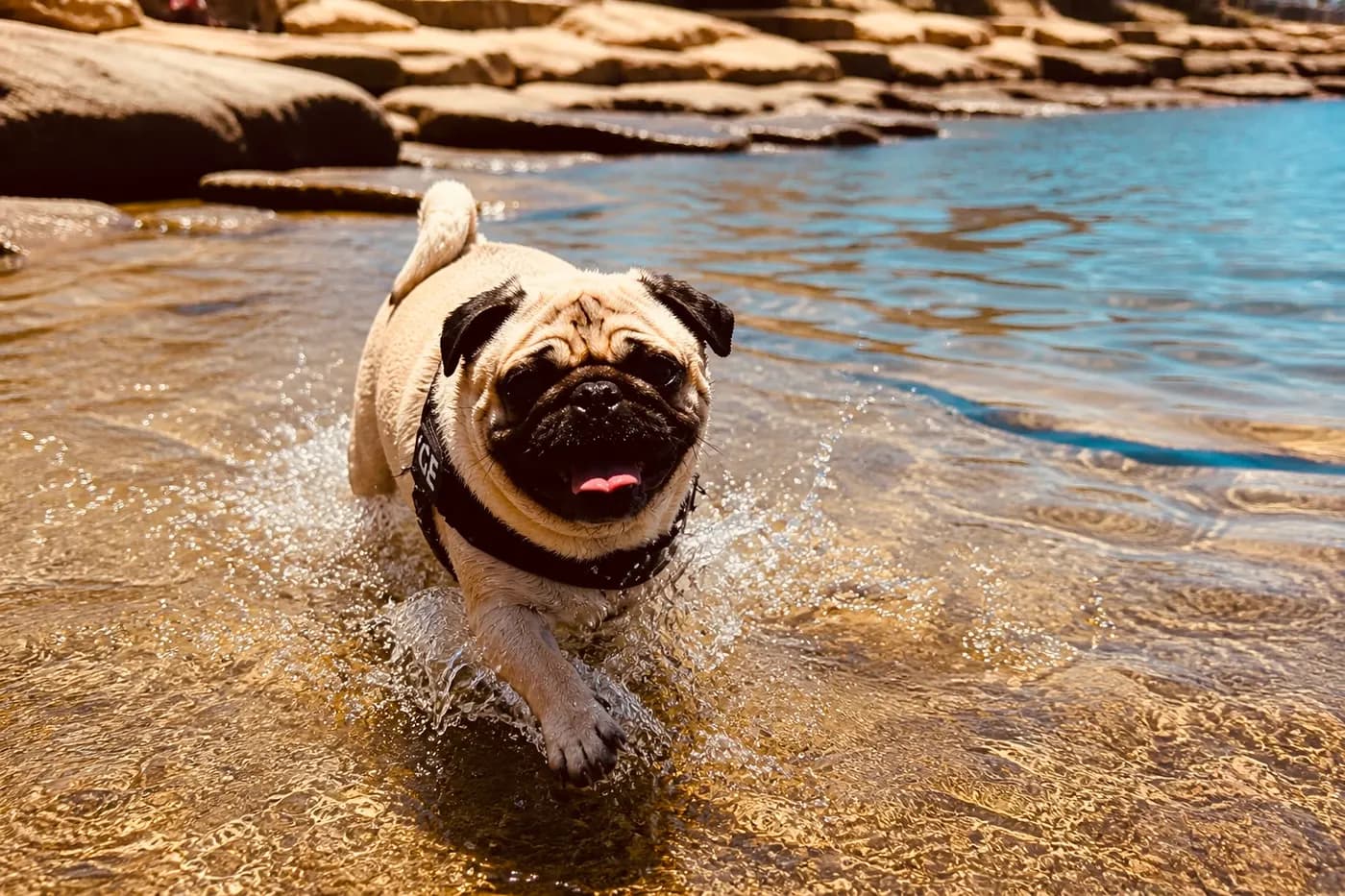
Pugs love water. Many Pugs adore splashing in shallow puddles, wading through creeks, and playing in kiddie pools. But they cannot swim safely. Their flat faces mean they have to tilt their heads so far back to breathe that their back ends sink. Combined with their compact, dense bodies, this makes anything deeper than belly-height genuinely dangerous.
Corgis, Dachshunds, and Basset Hounds have long bodies and short legs that make propulsion in water exhausting. They can paddle briefly but tire fast.
Boxers and Staffordshire Bull Terriers are muscular and athletic on land, but dense muscle and large heads work against them in water.
If your dog has a flat face, short legs, a heavy chest, or a large head relative to their body, treat them as a non-swimmer unless proven otherwise — and even then, use a life vest and supervise closely.
Swimming vs Paddling vs Wading: They’re Not the Same
This is the distinction most water guides miss. Dog owners often think the goal is swimming — getting your dog into deep water, fully floating, legs pumping. But for many dogs, the real joy is much shallower than that.
Wading — walking through ankle-to-belly-deep water — is enriching, cooling, and accessible to almost every dog. The sensation of water around their legs, the different textures underfoot, the smells carried by moving water — this is genuine sensory enrichment. A Pug wading through a creek is having a rich, happy experience even though they’ll never swim a stroke.
Paddling — shallow enough to touch the bottom but deep enough to start floating — is where many dogs find their comfort zone. They can feel the ground beneath them, which provides security, while experiencing the sensation of buoyancy. This is often where confident swimming begins, naturally and gradually.
Swimming — deep water, fully floating, no ground contact — is an entirely different experience. It requires trust, confidence, physical capability, and ideally a gradual buildup from wading to paddling to swimming over multiple positive experiences.
The mistake is treating swimming as the destination and wading as a stepping stone. For many dogs — especially flat-faced breeds, older dogs, dogs with joint issues, and anxious dogs — wading IS the destination. And it’s a perfectly good one. Just as chewing helps dogs decompress after stimulation, time at the water’s edge can be its own kind of settled satisfaction — without ever leaving the shallows.
How to Get It Right: Letting Your Dog Set the Pace
The golden rule is simple: your dog decides when and whether to go deeper.
Start shallow. Find a calm, shallow entry point — a gently sloping beach, a shallow creek, a lake edge with no current. Let your dog explore the water’s edge. Let them sniff it, paw at it, walk through the shallows. If they choose to go further, great. If they don’t, that’s also great. The first session is about positive association, not distance.
Go in with them. Your presence in the water is the most powerful confidence-builder. Walk in yourself, let them follow if they choose. Many dogs who hesitate at the edge will wade in to be near their person.
Never force, carry, push, or throw. One bad experience can undo everything. Puppies are especially vulnerable — a single frightening water experience during a fear period (8–12 weeks or 7–14 months) can create a lifelong aversion. The Golden Retriever who got thrown in the dam learned that water means panic, not play. That lesson stuck permanently.
Use other dogs. If your dog sees a confident swimmer enjoying the water, they’re far more likely to try it themselves. A play date with a water-loving dog at a calm beach or lake is one of the best introductions you can arrange. Praise and positive reinforcement at every voluntary step matters more than getting them deep.
Consider a life vest. Not just for breeds that can’t swim — life vests give any uncertain dog extra buoyancy and confidence. The feeling of floating without effort can transform a cautious paddler into a confident swimmer. And they have handles on top, so you can lift your dog out if needed.
Water Safety
Never leave your dog unsupervised near deep water. Even strong swimmers can drown if they become exhausted, get caught in a current, or can’t find an exit.
Blue-green algae can be lethal to dogs. Avoid stagnant water with visible algae blooms, and rinse your dog after swimming in any natural water.
Dry their ears. Water trapped in the ear canal causes infections, especially in floppy-eared breeds. (And don’t be surprised if they immediately roll in something awful right after you’ve cleaned them — the bath strips their scent, and they want it back.)
Know your exit. Pools with no ramp or steps are dangerous — a dog who can swim may not be able to climb out.
A dog who loves water has something extra in their life — an entire category of joy and enrichment that a water-averse dog misses. But that love has to be built, not forced. Let them wade before they paddle. Let them paddle before they swim. Let them decide. The dog who chooses the water on their own terms is the one who’ll keep going back.